
Best Trekking Poles for Hunting in 2026 (Researched & Compared)
Quick answer: these three routes describe carbon-shaft trekking poles with different grips and published weight bases. Compare the actual supplied configuration, fit and locks; neither baskets nor a material label guarantee stable ridge travel or safe pack-outs.
These three linked trekking-pole options are compared by seller-described shaft, grip, lock and weight basis. Independent lock-reliability and grip-comfort rankings are not established.
Start here — pick your hunting-pole job
Selection criteria
Compare the exact shaft and grip version, usable and packed lengths, complete carried weight, locking instructions and required accessories. No numerical lock-reliability, impact-strength, comfort or value ranking is established.
How we ranked these
Current route descriptions are checked against reachable Foxelli and Cascade family specifications. The PEAK WALK description remains seller evidence. Conflicting weights and differing tip configurations prevent a reliable lightest ranking; these are not field-test results.
Which poles for your hunt?
Public-land climbs with meat loads
Compare complete carried weight, grip fit and correct adjustment before attempting a loaded route. No vibration-damping winner is established here.
A few steep weekends a year
The PEAK WALK route is described as carbon/EVA, not aluminum. Verify adjustment and grip handling for yourself; no impact-durability advantage is established.
Soft snow and side-hill travel
Confirm the supplied baskets suit the intended surface. Baskets may reduce sinking but do not make snow or side-hill travel safe.
Do a bit of everything
Compare the supplied configurations against your route. All three linked options are described as carbon-shaft models; no aluminum alternative is verified here.
Foxelli Carbon vs Cascade Mountain Tech
Foxelli Carbon Fiber
- Seller states 7.6 oz per pole; no lightest ranking established
- Cork grips + quick-lock
- Trekking and snow baskets included
- Compare the current delivered offer
- Confirm adjustment range for your route
Cascade Mountain Tech
- Carbon-shaft family; check selected version
- Snow baskets in the box
- Check cork-grip fit with your gloves
- Lock collars need check-ups
- Compare required accessories and total cost
Hunting-pole notes (category benchmarks)
- Set elbows near 90° on flat ground, then shorten for climbs and lengthen slightly on loaded descents.
- Carbide tips bite rocky game trails; rubber tips save pavement and quiet approaches near the truck.
- These are trekking poles; firearm or crossbow support approval was not established for the linked models. Use equipment designed and approved for the intended task.
Decision rules
- Compare Foxelli if its actual grip, usable length and complete weight meet your needs.
- Consider PEAK WALK only after confirming the carbon/EVA version and supplied accessories.
- Compare Cascade with its actual tips and baskets fitted; do not compare a bare-shaft weight against a complete pole.
- Choose by exact locking instructions and condition, not an assumption that every flip lock outperforms every twist lock.
Why Trekking Poles Matter on Hunt Terrain
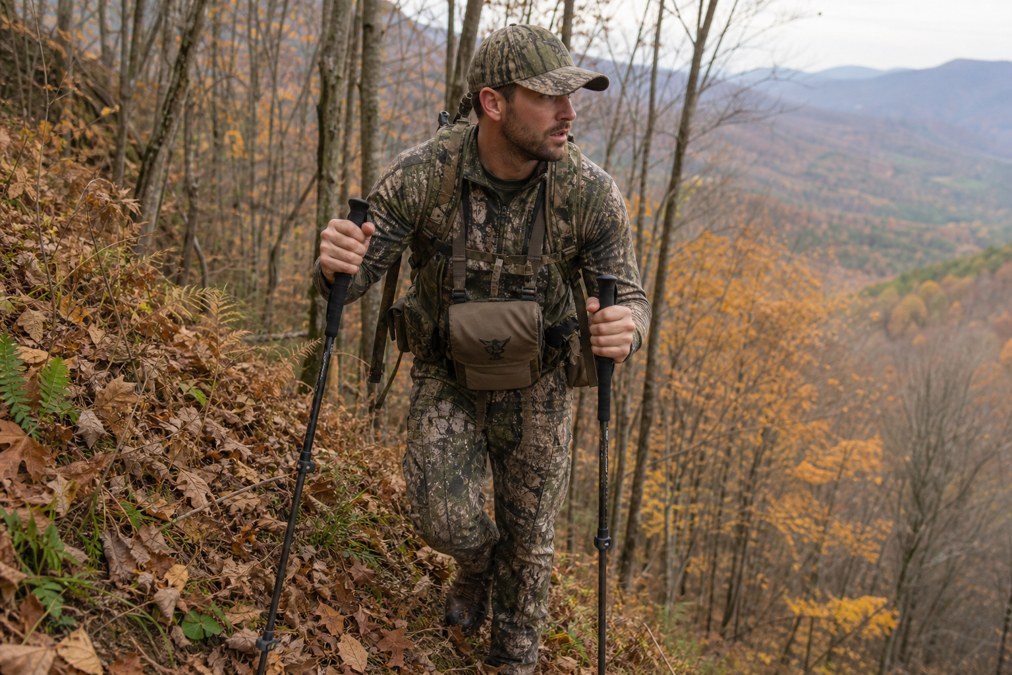
Steep ridge approaches with a rifle or quartered meat load punish knees on the way down — poles may assist walking, but do not guarantee joint relief or a safe stream crossing. Assess the route and turn back when conditions exceed your skills or equipment. Do not treat these trekking poles as verified shooting rests.
Check collapsed length, grip handling, lock operation and the accessories needed for your route. No acoustic test, impact test or universal carbon-versus-aluminum value conclusion is established for these linked versions.
What to Look For — Buyer’s Guide
Match the pole pair to your usable and packed length, complete carried weight, grip fit, lock instructions, terrain and the tips or baskets you will actually use.
Key Factors at a Glance
Shaft material alone does not determine weight, impact resistance or cost. Compare the complete supplied pole, its instructions and warranty; all three routes here describe carbon shafts.
Any adjustable pole can slip if damaged, dirty, incorrectly extended or poorly tensioned. Follow the exact lock instructions, respect extension marks and check locking under controlled load before relying on the poles. Lock style alone does not guarantee safe support.
Check actual cork-grip handling, including with gloves; check strap use against the maker’s instructions and terrain; no shooting-rest use is established.
Snow baskets may reduce sinking in suitable soft snow, but trekking poles do not provide traction, avalanche protection or a self-arrest system. Choose terrain and equipment appropriate to conditions; turn back when safe footing is uncertain.
Put single-pole and pair weights on the same basis
Cascade’s carbon quick-lock cork specification lists 8.1 oz for one pole without rubber tips. On that stated basis, two poles total 16.2 oz before the excluded tips or any other separately carried accessories. This is arithmetic from a published specification, not our measured pair weight.
Foxelli’s family page gives a different figure from the linked seller description already noted above. Do not turn those inconsistent numbers into a lightest-product verdict. Instead, use a scale or obtain a written weight for the exact supplied pair with the tips, baskets and case you will actually carry.
Keep these four fields together when comparing an offer: exact model/configuration, single or pair basis, included accessories and usable/collapsed length. For replacement sections, match the maker’s part reference to the model and lock system; a matching nominal pole length does not establish interchangeability. Shaft material and a small weight difference do not establish lock reliability or suitability for shooting support.
The 3 Best Trekking Poles for Hunting in 2026
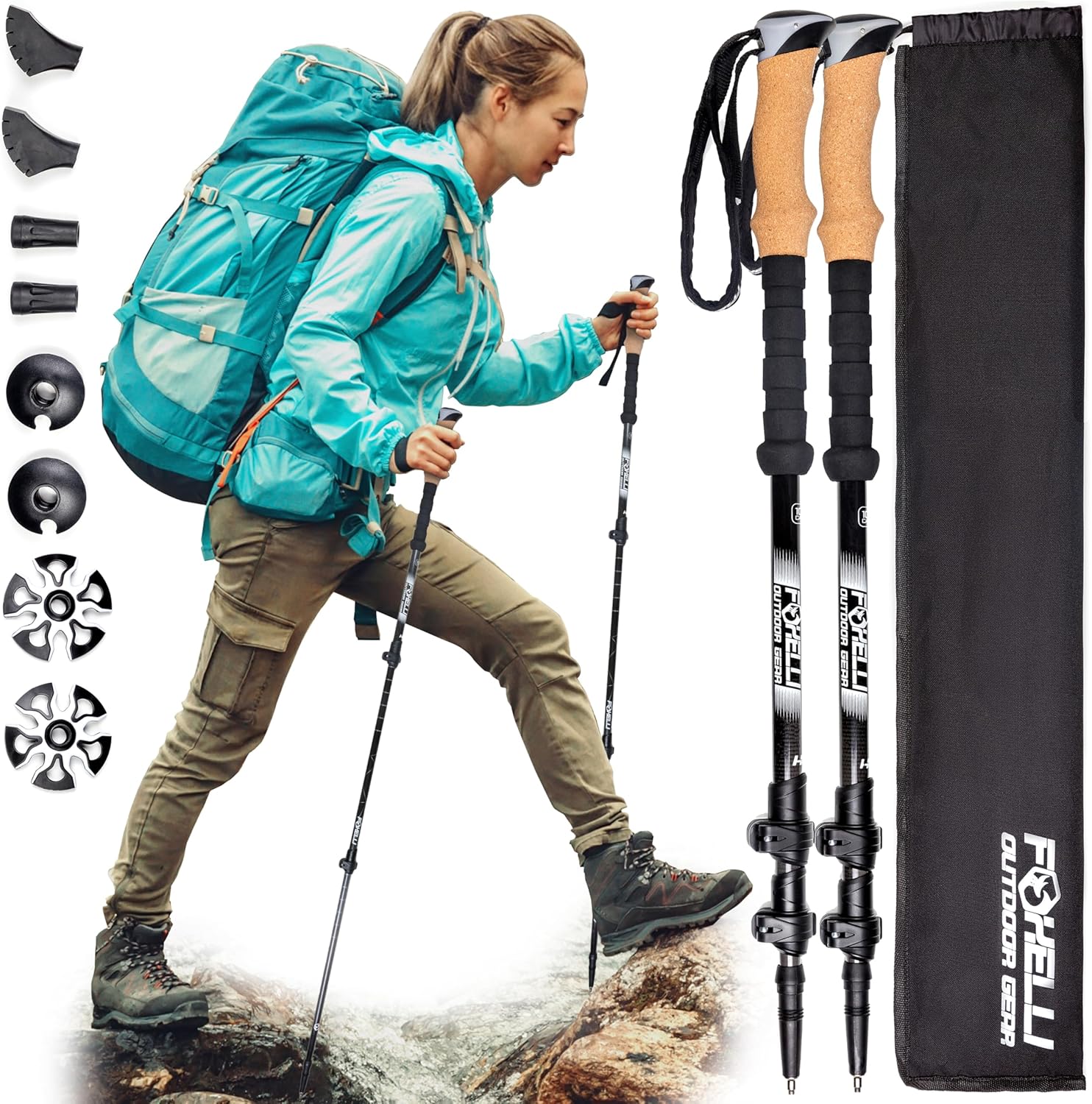
Foxelli Carbon Fiber Trekking Poles
| Material | Carbon fiber |
|---|---|
| Weight | Seller: 7.6 oz each |
| Lock | Quick-lock |
| Best for | All-season hunting |
Buy this if
- Do multi-day public-land climbs where ounces matter
- Can operate the supplied locks with your intended gloves after following the maker’s instructions
- Need snow baskets for late-season side-hills
Skip if
- The actual usable or packed length does not fit your needs
- Expect lateral impacts or damage; choose suitable equipment and inspect it
- Need a verified lowest delivered price; no current ranking is established
Pros
- Seller states 7.6 oz per pole; verify supplied configuration
- Check actual cork-grip handling, including with gloves
- Quick-lock adjusts for uphill and downhill
- Trekking and snow baskets included
Cons
- Carbon can crack on rock impacts
- No current cross-material price ranking
Complete the kit
PEAK WALK 3K Carbon Trekking Poles
| Material | Seller-described 3K carbon |
|---|---|
| Lock | Flip-lock |
| Tips | Multiple options |
| Best for | Occasional hunts |
Buy this if
- Hunt steep terrain only a few weekends a year
- Want to compare the linked carbon/EVA configuration
- Prefer flip-lock collars you can work with gloves
Skip if
- Need a confirmed complete-pole weight before comparing options
- Need included snow baskets for late season (see Cascade)
- Need independently measured vibration-damping performance
Pros
- Seller-described carbon shaft configuration
- Flip-lock adjusts with gloves on
- Multiple tip options for trail conditions
- Inspect shafts and locks; no abuse tolerance guaranteed
Cons
- Published shaft/material fields are inconsistent; confirm before purchase
- No comparative fatigue trial established here
Complete the kit
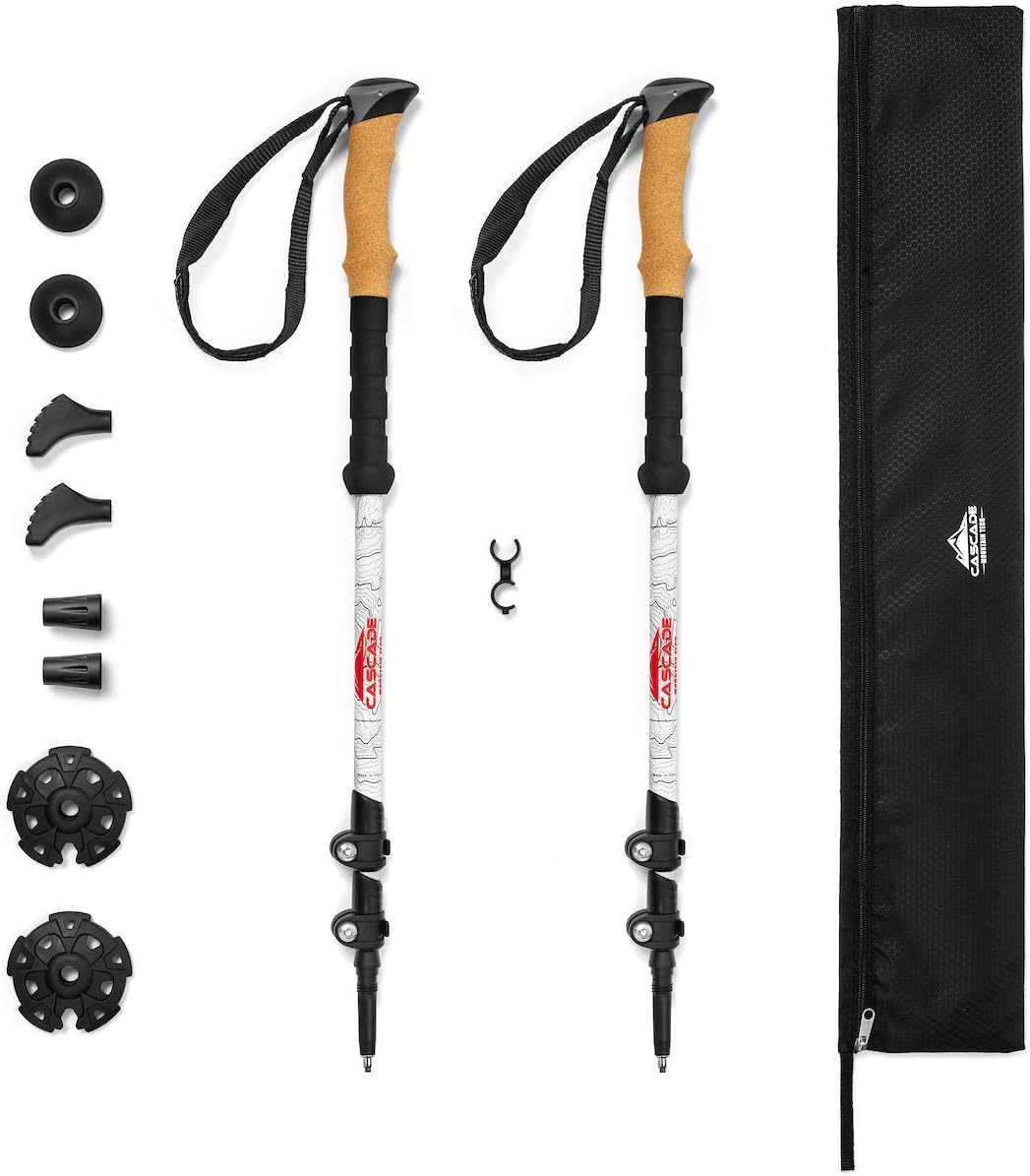
Cascade Mountain Tech Trekking Poles
| Material | Carbon fiber; exact version/configuration matters |
|---|---|
| Lock | Quick-lock |
| Baskets | Snow baskets included |
| Best for | Mountain terrain |
Buy this if
- Want to compare the actual Cascade carbon/cork configuration
- Hunt late season and need snow baskets in the box
- Prefer cork grips on long approaches
Skip if
- Need a proven lightest option; published weights use differing or unclear bases
- Prefer an independently verified aluminum option; none is established here
- Hate checking lock collars after hard use
Pros
- Carbon-shaft option
- Quick-lock with cork grip comfort
- Snow baskets included for late season
- Inspect the complete supplied pole
Cons
- No comparative finish assessment established
- Follow the selected model’s lock inspection and adjustment instructions
Complete the kit
Model references: Foxelli carbon family and Cascade carbon quick-lock cork family. PEAK WALK figures are seller descriptions; supplied-version and weighing-basis checks remain necessary.
Pre-hunt pole check
- Confirm both poles are the intended version and fit the pack when collapsed.
- Inspect shafts, tips, straps and locks; set usable length without crossing extension marks.
- Follow the maker’s lock-tension procedure and check for slipping on secure level ground before a loaded walk.
- Use intended gloves and the accessories actually carried when checking grip and total weight.
- Plan where to stow the poles when hands are needed for another task; these are not verified shooting rests or fall-arrest equipment.
See REI’s pole selection guidance and the hiking essentials guide for the rest of the route plan.
Full Comparison Table
| Product | Material | Best For | Buy |
|---|---|---|---|
| Foxelli Carbon Fiber Trekking Poles | Carbon | All-season hunting | Amazon → |
| PEAK WALK 3K Carbon Trekking Poles | Seller-described 3K carbon | Occasional hunts | Amazon → |
| Cascade Mountain Tech Trekking Poles | Carbon | Mountain terrain | Amazon → |
Common mistakes
- Extending beyond the maker’s marks or using dirty, damaged or incorrectly tensioned locks.
- Treating a snow basket as traction equipment or permission to enter unsafe terrain.
- Using one length despite a poor fit; adjust within the exact model’s range and instructions.
- Assuming rubber or carbide tips cannot slip; footing and surface conditions still matter.
- Buying by a carbon label or price tier without confirming grip, packed length and the full carried kit.
Frequently Asked Questions
Are trekking poles worth it for hunting?
Carbon vs aluminum trekking poles for hunting?
Can you use trekking poles as a shooting rest?
Do hunting trekking poles need snow baskets?
What length should hunting trekking poles be set to?
Are twist-lock poles OK for hunting?
Related Guides


