
Best Water Filters for Camping & Backpacking in 2026 (Researched & Compared)
Quick answer: choose water treatment by the actual source hazards and the exact model’s documented coverage, then compare collection format and carried kit. Sawyer, BeFree, GravityWorks and Hiker Pro are not virus purifiers. No location or clear appearance proves that a source is safe.
These five options cover squeeze, collapsible flask, group gravity, hand pump and bottle-purifier formats. The right format still needs documented pathogen coverage, correct operation and a usable backup plan.
Collection convenience and treatment coverage are different decisions. Keep the corrected model specifications below, but check the exact instructions and actual source hazards before relying on any device.
Related guides: gravity systems · pump formats · virus-treatment choices · treatment workflow.
Start here — pick your filter job
Selection criteria
Compare documented pathogen coverage, carried kit, collection format, maintenance and the selected offer. No numerical performance ranking is presented; we have no documented side-by-side flow, durability or field test.
How to use this comparison
These five formats address different collection and carrying needs. Recommendations do not establish that a source is safe or every claimed cartridge specification has been independently tested. Check exact model instructions before use.
CDC treatment guidance distinguishes filters, disinfection and boiling, and advises against using chemically contaminated sources. Aquamira 1oz drops claims do not establish a universal virus-backup role.
Model specification references
- GravityWorks specifications
- Katadyn Hiker Pro regional specifications
- GRAYL specifications and replacement criteria
Linked models reviewed 19 October 2026. Confirm the selected variant, contents and current offer; published performance is not our field-test result.
Which filter for your trip?
Source assessment and documented coverage first
Use only compatible containers and an appropriate treatment plan.
Compare the whole carried kit
Collapsible drinking-flask format; follow exact instructions.
Dinner rush liters
Hang dirty bag; walk away.
Assess the actual hazards first
Choose only after matching documented treatment coverage to the actual source hazards; a country label alone does not establish them.
Sawyer Squeeze vs Grayl GeoPress
Sawyer Squeeze
- Microfilter; not virus treatment
- Approx. 3 oz filter-only basis
- Add compatible containers and cleaning items
- Follow Sawyer-specific maintenance and freeze guidance
Grayl GeoPress 24 oz
- Check exact cartridge pathogen coverage
- 15.9 oz manufacturer empty bottle basis
- Bottle press format, not a group reservoir
- Follow cartridge age, press-effort and replacement criteria
Water notes that matter
- Clear water can contain pathogens. Assess the actual source rather than assuming a flowing stream or country is safe.
- Prevent wet hollow-fiber filters from freezing and follow their own instructions if freezing is suspected.
- Keep dirty containers and fittings separate from clean water and drinking surfaces.
- Use only the cleaning, sanitizing and storage method permitted for the exact filter; backflushing is not universal.
Decision rules
- Choose a treatment method with documented coverage for the actual hazards; these microfilters are not virus purifiers.
- Compare BeFree for a collapsible drinking flask, without transferring BeFree AC carbon-stage specifications.
- Compare GravityWorks when reservoir capacity and a suitable hanging arrangement fit the group.
- Compare Hiker Pro when hose collection suits the source; shallow water is not inherently safe water.
- Compare GeoPress only against the exact cartridge’s stated coverage and replacement instructions; no system here authorizes use of suspected chemically contaminated water.
How to Choose a Camping Water Filter
Match the tool to the job. Solo backpacking wants ounces. Base camp wants liters. Shallow seeps want a pump. A purifier must match the actual hazards; avoid sources with suspected harmful chemical contamination. Child guides dig deeper: gravity, pump, viruses, and how to filter water.
What to Look For — Buyer’s Guide
Choose documented treatment coverage first, then compare the complete carried kit and the collection format for your group.
Key Factors at a Glance
Check the exact model’s organism claims and test basis. A pore-size or purifier label alone is not a complete treatment plan.
Squeeze for solo; gravity for groups; pumps for shallow scoops.
Use model-specific maintenance; prevent wet hollow fibers from freezing.
Compare group capacity, collection access and carried kit only after checking the source hazards and documented treatment coverage.
Group capacity is different from headline flow
Work out how much treated water must be ready for the next meal or refill, then compare the number of collection and treatment batches. Count only water that has completed the required treatment, and keep untreated and clean storage separate.
Worked capacity example: suppose your group needs 6 litres ready at camp. That is an illustrative task, not a recommended daily allowance. The 710 ml GeoPress capacity requires at least nine nominal full-capacity batches: 6 ÷ 0.710 rounds up to 9, providing 6.39 litres before transfer losses. Check fill limits and operate each batch under the current instructions.
A 4-litre dirty reservoir instead needs at least two collection loads for that same volume. A separate 4-litre clean reservoir does not turn one dirty fill into 8 litres of treated water. Empty or transfer treated water hygienically before exceeding the clean reservoir’s limit.
This arithmetic explains handling effort, not which system treats the source adequately or finishes first. Do not multiply a manufacturer’s press time or advertised litres per minute into a guaranteed camp-ready time: collection, preparation, transfer, maintenance and any required disinfection also matter. GRAYL publishes the 710 ml capacity and cartridge criteria; compare the complete system against your actual group’s task. Use our treatment workflow and backup-planning guide for the separate safety sequence.
The 5 Best Water Filters for Camping in 2026
Sawyer Squeeze Water Filter System
| Weight | ~3 oz |
|---|---|
| Pore | 0.1 micron |
| Life | Follow current Sawyer maintenance and replacement instructions |
| Best for | Most backpacking |
Buy this if
- The actual source hazards fit its documented coverage
- You accept the required containers and model-specific maintenance
- Smartwater bottles already in the kit
Skip if
- You need virus treatment beyond this microfilter’s coverage
- You refuse any pouch squeezing
- You only camp at treated spigots
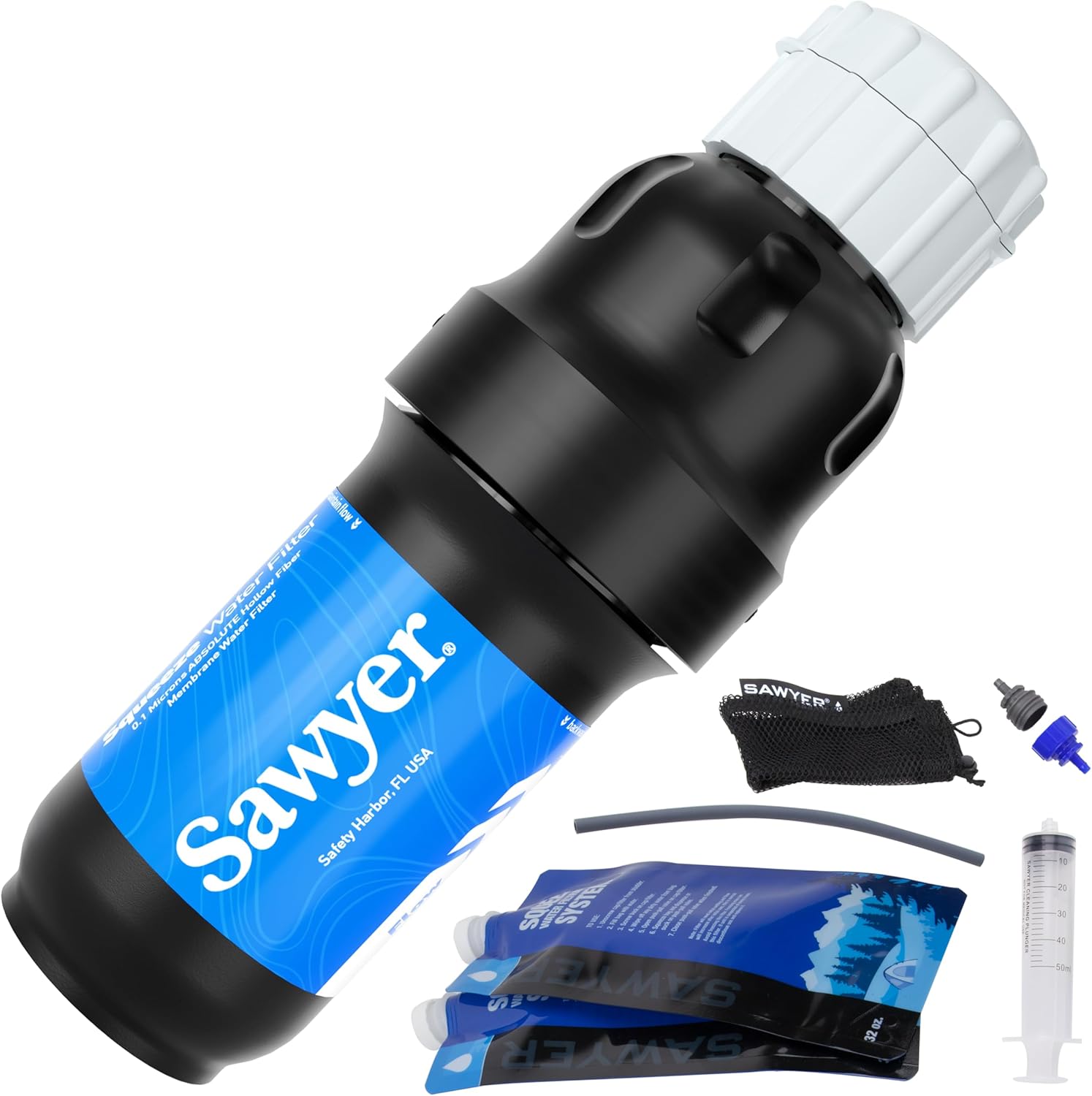
The linked Sawyer Squeeze SP129 is a 0.1-micron absolute hollow-fiber microfilter route for bacteria, protozoa and microplastics; it is not virus treatment. The filter-only basis is about 3 oz, so include compatible containers and cleaning items when comparing carried systems.
Backwash and store it according to the supplied Sawyer instructions, protect a wetted filter from freezing, and replace it if damage is suspected. Source conditions and maintenance affect flow; this page has no documented field test establishing daily throughput, durability or a universal winner.
Pros
- Compact filter-only format; include containers
- Cleaning supported by manufacturer instructions
- Smartwater compatible
- Two pouches included
Cons
- Not established as virus treatment
- Pouches wear over seasons
Complete the kit
Katadyn BeFree 1.0L Water Filter
| Linked model | BeFree 1L collapsible filter bottle |
|---|---|
| Membrane | 0.1 micron hollow fiber |
| Published flow | Up to 2L/min; condition-dependent |
| Published life | Up to 1000L; water-quality dependent |
Consider it if
- You prefer a collapsible fill-and-drink format
- The flask fits your carrying setup
Choose another option if
- You need a group reservoir
- You expect carbon filtration or virus treatment
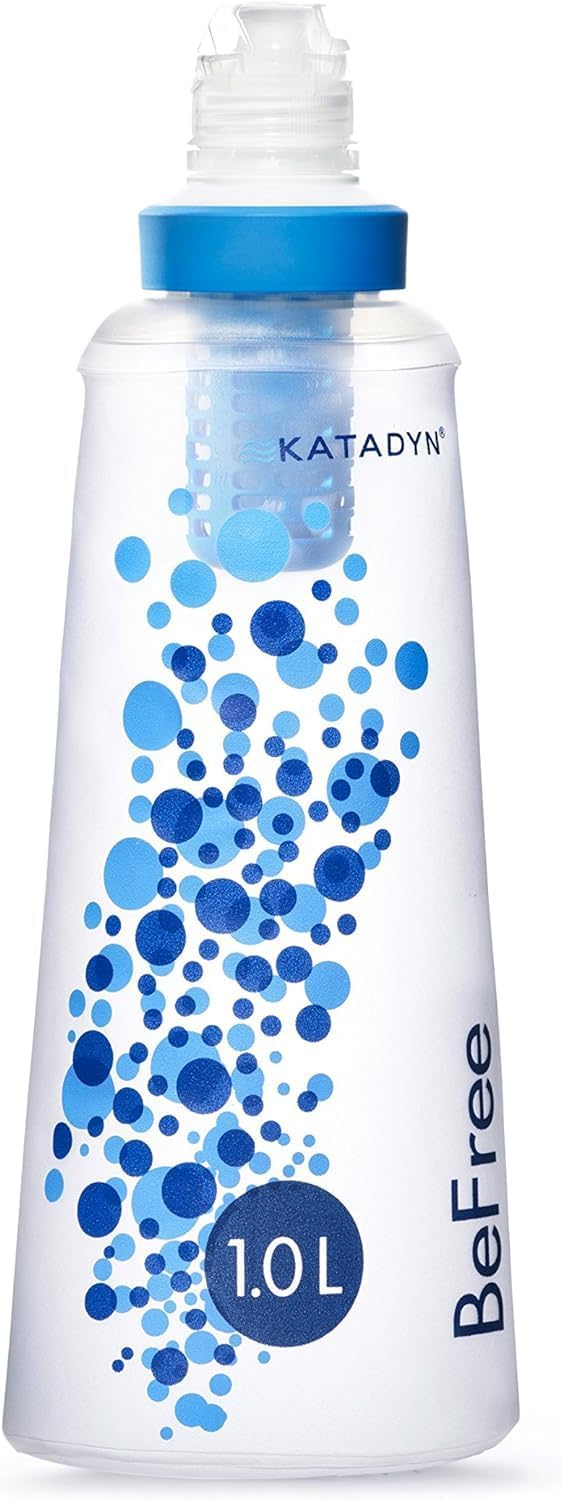
The linked BeFree is the original 1L collapsible format. Do not transfer BeFree AC carbon-stage specifications to it. The listing describes shake or swish cleaning without backflushing. Its published flow is not our measured comparative result. Confirm the complete carried weight and inspect the flask before the trip.
Pros
- Collapsible bottle
- No backflush syringe required
Limitations
- Flask condition needs checking
- Flow and life vary with conditions
Complete the kit
Platypus GravityWorks 4.0L Water Filter System
| Linked system | GravityWorks 4L reservoir pair |
|---|---|
| Manufacturer system weight | 11.5oz /326g for 4L system |
| Published flow | Up to 1.75L/min; condition-dependent |
| Manufacturer life | Up to 1500 liters, not 1500 gallons |
Consider it if
- You need group reservoir capacity
- You have a suitable hanging setup
Choose another option if
- You need a small drinking flask
- You require virus treatment from this microfilter alone
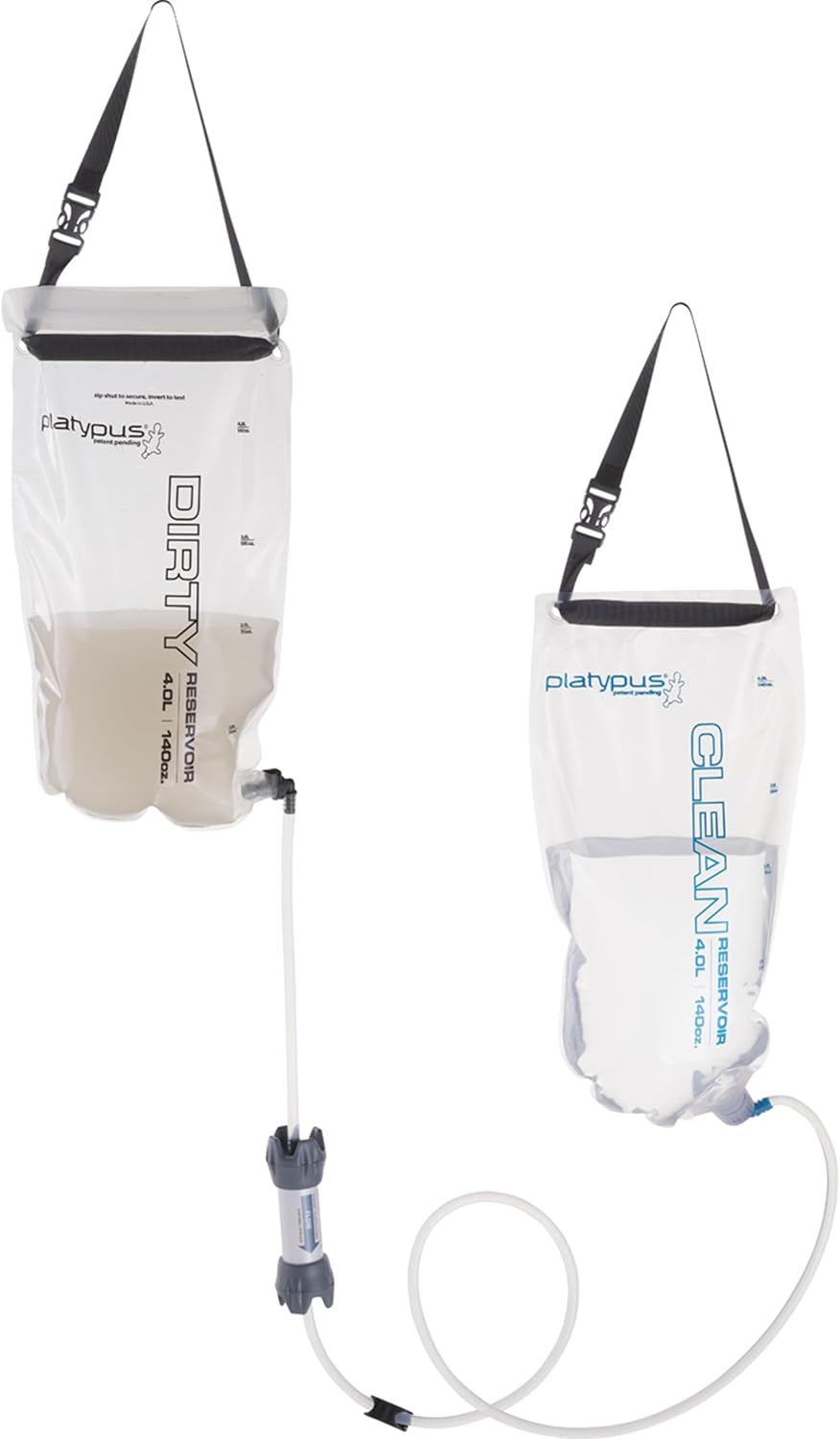
Separate reservoirs support group collection without hand pumping. The Amazon feature text says 1500 gallons, but the manufacturer specifies up to 1500 liters; use the manufacturer figure and its conditions. A suitable hanging arrangement and careful handling of clean fittings still matter. Neither flow nor cartridge life is a guaranteed field result.
Pros
- No hand pumping
- Separate dirty and clean reservoirs
Limitations
- Hanging setup required
- Keep dirty water away from clean fittings
Complete the kit
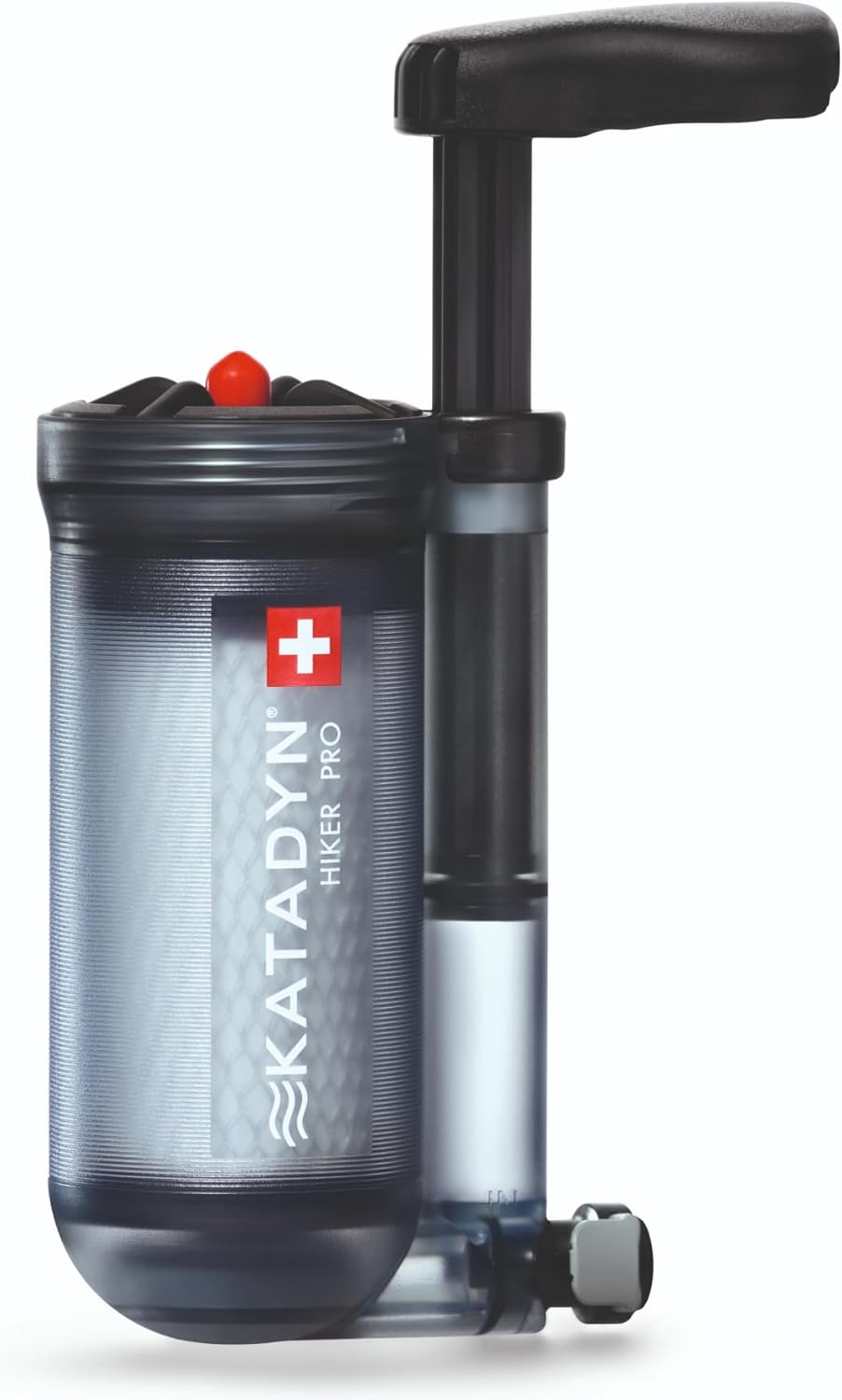
Katadyn Hiker Pro Transparent
| Linked model | Hiker Pro Transparent |
|---|---|
| Medium | 0.2 micron glass fiber; activated carbon |
| Published life | Up to 1150L; water-quality dependent |
| Weight basis | Listing 11.2oz; regional manufacturer 233g — verify kit |
Consider it if
- A hose suits your collection point
- You accept manual pumping and maintenance
Choose another option if
- You want gravity-fed collection
- You need virus treatment from this microfilter alone
An intake hose can help where scooping into a reservoir is awkward. The current transparent Hiker Pro listing specifies up to 1150 liters rather than the old 750L-class description. Weight figures conflict between the listing and regional manufacturer page; confirm the actual unit and accessories instead of treating them as equivalent kit measurements. Carbon does not make suspected chemically contaminated water safe.
Pros
- Hose-based collection
- Replaceable cartridge
Limitations
- Manual pumping
- Weight basis requires checking
Complete the kit
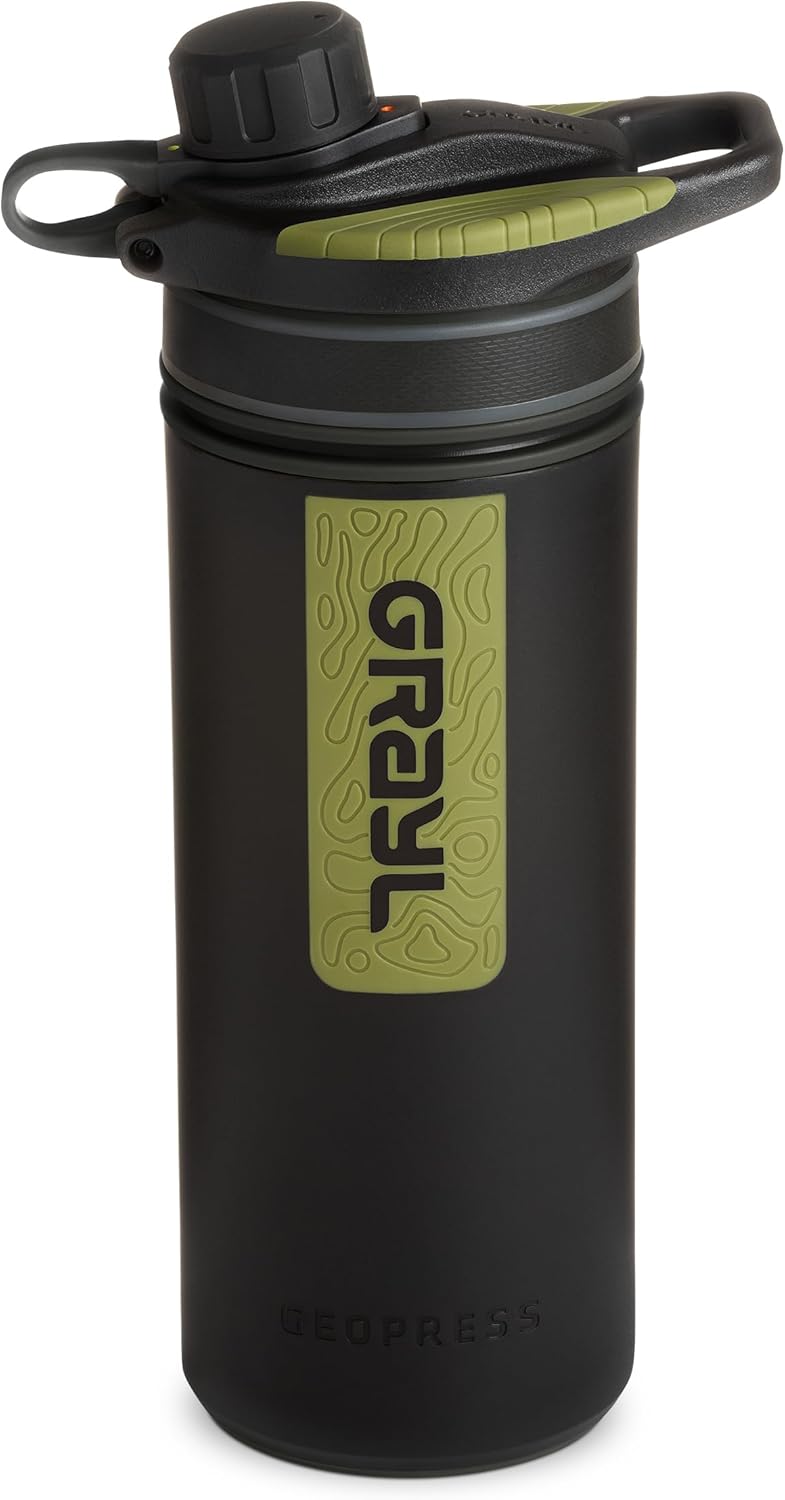
Grayl GeoPress 24 oz
| Linked variant | GeoPress 24oz Black Camo; not titanium |
|---|---|
| Manufacturer empty weight | 15.9oz /450g |
| Published press time | 8seconds per 24oz; condition-dependent |
| Cartridge | Rated 250L; press-time and age limits also apply |
Consider it if
- You prefer an all-in-one bottle press
- Its documented coverage matches your plan
Choose another option if
- You need a filter-only lightweight kit
- You expect one press to fill a group reservoir
The linked variant is the 24oz Black Camo bottle. GRAYL advises replacing its cartridge as press time approaches 25seconds or three years after first use; follow the current supplied instructions. Published speed and life are not guaranteed field results. Its stated pathogen coverage differs from the microfilters here, but does not authorize drinking suspected chemically contaminated water.
Pros
- Bottle and purifier together
- Published replacement criteria
Limitations
- Higher empty system weight
- Monitor cartridge age and press effort
Complete the kit
Check the complete water-treatment kit
- Identify the source and known hazards before selecting a device; avoid suspected harmful chemical contamination.
- Match exact model/cartridge coverage to the plan and keep its operating instructions accessible.
- Pack compatible dirty and clean containers, fittings and permitted cleaning items; compare this full carried weight.
- Rehearse collection and clean-side handling before departure. Protect wet hollow fibers from freezing.
- Carry enough safe water or an appropriate alternative treatment method if the device clogs, breaks or cannot be used.
CDC’s outdoor water-treatment guidance explains the differences among treatment methods. Use our step-by-step water guide for the workflow rather than interpreting a shopping comparison as a complete treatment protocol.
Full Comparison Table
| Product | Type | Weight | Best For | Buy |
|---|---|---|---|---|
| Sawyer Squeeze Water Filter System | Squeeze | Approx.3oz filter only | Backpacking, thru-hiking | Amazon → |
| Katadyn BeFree 1.0L Water Filter | Collapsible flask filter | Compare complete 1L flask kit | Day hikes, trail running | Amazon → |
| Platypus GravityWorks 4.0L Water Filter System | Gravity | 11.5oz manufacturer 4L system | Base camp, family camping | Amazon → |
| Katadyn Hiker Pro Transparent | Pump | Conflicting figures; verify kit | Desert hikes, group fill-ups | Amazon → |
| Grayl GeoPress 24 oz | Press purifier | 15.9oz empty bottle | Sources where its documented purifier coverage matches the assessed hazards | Amazon → |
Common mistakes
- Choosing by clear appearance or country instead of the actual source and documented coverage.
- Assuming every filter can be backflushed; follow the exact model’s maintenance method.
- Relying on a potentially frozen or damaged filter because water still flows through it.
- Mixing dirty hoses, caps or hands with clean drinking surfaces.
- Transferring one disinfectant’s dose or contact time to another, or having no usable alternative if the device fails.
Frequently Asked Questions
Do I need a water filter for car camping?
Filter vs purification tablets?
How do camping water filters work?
What is the best water filter for backcountry camping?
What is the best budget camping water filter?
Best water filter for winter camping?
Best water filter for car camping vs backpacking?
How do I store a water filter after camping?
Related Guides


