
Portable Power Stations for Camping: 3 Options Compared
Which power station fits your camping trip?
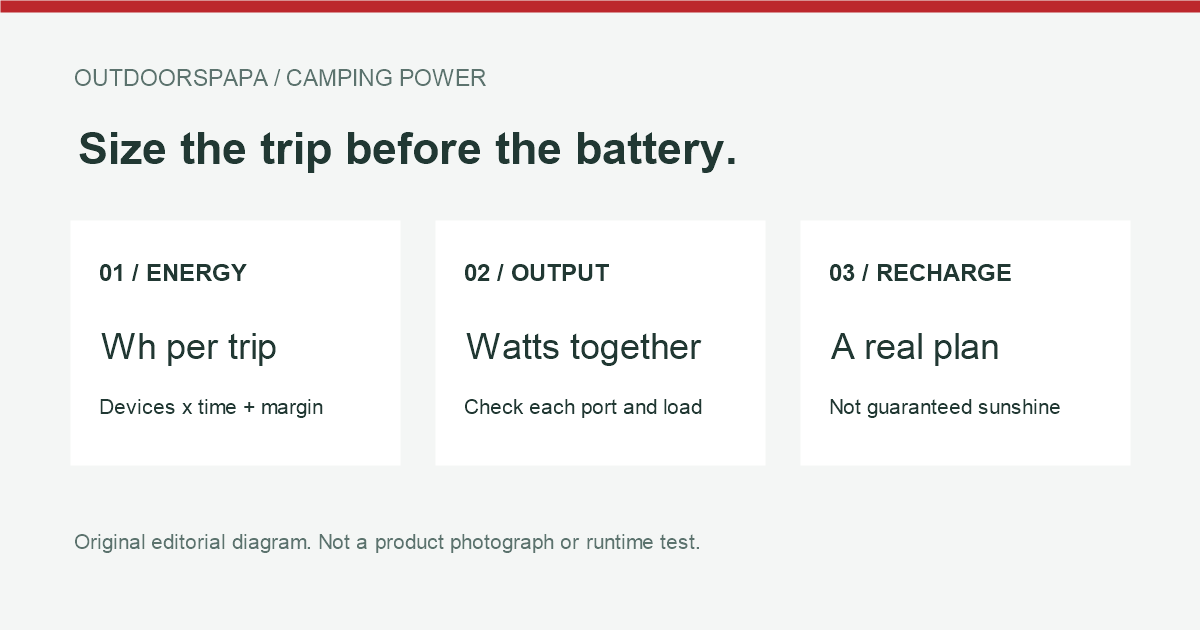
For car camping, start with the energy your trip needs, then check the outlets and carrying weight. The Anker SOLIX C1000 Gen 2 is our starting comparison for a fixed-capacity 1kWh setup. Choose the EcoFlow DELTA 3 instead if a supported extra-battery path matters; consider the larger Jackery Explorer 2000 v2 when the trip calculation calls for roughly twice the stored energy. None is a sensible default for a backpacking trip or a weekend that only needs phone charging.
A fridge, laptop and lights can turn a quiet campsite into a comfortable base. They can also turn a battery purchase into an expensive guessing game. This guide is for US car campers comparing larger rechargeable stations, not fuel generators or whole-home electrical installations.
Choose by the problem you need to solve
What matters in this comparison
We compare five practical questions: whether the battery covers the trip, whether its outputs suit the appliances, how it will recharge, whether you can carry the complete kit, and whether the selected Amazon package includes what you need. We do not award numerical scores, rank by commission or treat peak watts as continuous output.
How we compared
We reviewed manufacturer US specifications and the named Amazon.com listings on 20 November 2026. These are researched editorial comparisons, not hands-on tests. The listed weight is the station, not a complete solar kit. We have not measured usable energy, noise or real-world recharge times. Our shopping view was set to India, so this review does not establish current US delivery, stock or checkout pricing.
Compare the three options
| Model | Rated energy | Continuous AC | Net weight | Key tradeoff | Amazon |
|---|---|---|---|---|---|
| Anker SOLIX C1000 Gen 2 | 1024Wh | 2000W | 24.9 lb | No extra-battery expansion | Check on Amazon → |
| EcoFlow DELTA 3 | 1024Wh | 1800W | 27.6 lb | Supports specified EcoFlow extra batteries; sold separately | Check on Amazon → |
| Jackery Explorer 2000 v2 | 2042Wh | 2200W | 39.5 lb | Compare as a standalone 2,042Wh unit; not the 2000 Plus | Check on Amazon → |
These are manufacturer-rated values, not our measurements. All AC wattages are total continuous output, not a per-outlet allowance. Capacity is nominal stored energy. Neither figure alone predicts a fridge runtime.
Anker SOLIX C1000 Gen 2
| Rated energy | 1,024Wh |
|---|---|
| Continuous AC output | 2,000W total |
| Manufacturer net weight | 24.9 lb |
| Expansion | Fixed capacity; not expandable |
Buy this if
Your calculation fits a 1kWh battery and you value lower carrying weight over future expansion.
Skip this if
You expect to add an extra battery later, or need more trip energy without recharging.
This is a useful starting point when you want one box rather than a growing battery system. Its higher continuous-output rating does not give it more stored energy than the DELTA 3: an appliance that fits the inverter still needs a runtime calculation. Anker's advertised 49-minute recharge requires its app-enabled UltraFast mode and suitable conditions; plan around the actual charging opportunity rather than that headline alone.
Advantages
- Lower listed weight than the other two options
- Useful continuous-output headroom for compatible appliances
Tradeoffs
- Cannot grow through extra batteries
- Fastest charging mode requires app setup
Specification reference:
Anker SOLIX C1000 Gen 2 manufacturer informationEcoFlow DELTA 3
| Rated energy | 1,024Wh |
|---|---|
| Continuous AC output | 1,800W total |
| Manufacturer net weight | About 27.6 lb |
| Solar input ceiling | 500W; not the DELTA 3 Plus specification |
Buy this if
You want a 1kWh starting battery with a manufacturer-supported extra-battery route.
Skip this if
You want the lightest option here, or need the Plus model's different charging features.
The reason to shortlist the standard DELTA 3 is its expansion option, rather than an assumed runtime advantage at the base size. Extra batteries add purchase cost, packed volume and another heavy item to move. Its 500W solar-input ceiling belongs to this model; do not use DELTA 3 Plus specifications when choosing a panel package. EcoFlow's battery-pack protection wording also does not establish that the complete power station can sit in the rain.
Advantages
- Compatible extra-battery options
- Multiple AC and DC connections
Tradeoffs
- Heavier than the Anker at the same nominal energy
- Extra batteries and panels increase the complete-kit cost
Specification reference:
EcoFlow DELTA 3 manufacturer informationJackery Explorer 2000 v2
| Rated energy | 2,042Wh |
|---|---|
| Continuous AC output | 2,200W total |
| Manufacturer net weight | About 39.5 lb |
| Solar input ceiling | 400W; confirm connectors and panel pairing |
Buy this if
The trip needs more energy than a 1kWh unit can comfortably supply and you can manage the heavier lift.
Skip this if
Your load is small, you have reliable daily recharging, or the campsite is a long carry from the car.
More stored energy is the main reason to step up. It gives a larger starting budget without assuming sunlight will rescue an undersized battery. The compromise is a noticeably heavier box, especially after adding panels and cables. This is the Explorer 2000 v2, not the 2000 Pro, 2000 Plus or HomePower 2000 Plus v2. Check the selected name carefully because their packages and capabilities are not interchangeable.
Advantages
- Nearly twice the nominal energy of the two 1kWh units
- A standalone larger-capacity option
Tradeoffs
- Highest carrying weight of these three
- A bigger battery does not make solar recharging instant
Specification reference:
Jackery Explorer 2000 v2 manufacturer informationEstimate your camping battery needs
Start with measured daily energy where possible. The example entries below are hypothetical planning inputs, not measurements of a fridge or these power stations. Set unused loads to 0. No recharge is credited; that keeps uncertain sunshine out of the starting budget.
Formula: nominal Wh = trip-load Wh ÷ [efficiency fraction × (1 − reserve fraction)]. With the example 600Wh/day for two days, 85% efficiency and 20% reserve, the result is about 1,765Wh. That points toward comparing the larger capacity class; it does not verify a specific product runtime or appliance compatibility.
How to choose before you shop
Separate watts from watt-hours
Watts describe power at a moment in time. Watt-hours describe energy used over time. A 1,000W appliance used for six minutes needs about 100Wh before losses; a steady 20W device running for ten hours needs 200Wh. A bigger inverter rating does not by itself mean longer runtime. Check the combined continuous load as well as any starting requirement.
Measure the fridge instead of borrowing a duty cycle
A compressor fridge switches on and off. Temperature, setpoint, ventilation and how often you open it change the daily energy use. Use a measured Wh/day figure from your own setup where possible. If you only know the compressor's running watts, a guessed percentage of on-time is an assumption, not a product specification. Enter a conservative daily figure and revisit it after measuring.
Allow for losses, reserve and small continuous drains
The battery's label is not the energy every appliance receives. Conversion losses and the station's own electronics reduce useful output, especially with an AC inverter left on for small loads. Our calculator uses an editable delivery-efficiency assumption plus a separate reserve share. These are planning allowances, not measured efficiencies for these models. Temperature and battery condition can require more margin.
Buy a charging plan, not just a battery
An overnight recharge at a powered campsite is a different situation from three parked days under trees. Check the manual's AC input, allowed car connection and solar limits. A high-wattage alternator charger is a separate accessory and installation, not the performance of an ordinary vehicle socket. If a device must keep running while charging, verify that exact mode and output limits.
Check the whole package and the path from car to tent
The station, solar panel, panel cable, car cable and carry bag may be separate items. Read the selected Amazon option before comparing totals. Leave room for cooling and protect equipment from weather according to its manual. Try lifting a similar weight before planning repeated carries. Camping with electricity should simplify the trip rather than become its heaviest chore.
Know when a smaller solution is enough
For a phone, headlamp and camera, a suitable USB power bank may be all you need. These larger stations suit car-based trips with appliances or a substantial electronics budget. They are not a reason to replace a lightweight backpacking kit. If your campsite already has a suitable electrical hookup, compare that arrangement before buying an additional battery.
Three trip decisions worth making first
Phones, lights and a short laptop session
Make a list of actual recharges rather than leaving every device connected all day. If the total is only a few hundred watt-hours for the whole trip, compare a smaller station or USB bank. Buying 2kWh simply because it is a bigger discount leaves you carrying capacity you did not need.
A fridge at a parked campsite
Pre-cool food using mains power before departure where practical, then measure the fridge in representative conditions. In the calculator, a hypothetical 480Wh/day fridge plus 120Wh/day of other loads needs 1,200Wh delivered over two days. That example exceeds a 1,024Wh label even before conversion losses. A larger battery, a measured reduction in demand or a dependable recharge is needed; an optimistic duty cycle is not a solution.
Cooking or heating with electricity
Short high-power tasks and all-night loads are different problems. A hypothetical 1,000W kettle used for six minutes takes 100Wh before losses. A 500W heater used for eight hours takes 4,000Wh before losses. None of these standalone batteries should be bought on the assumption it will handle that heater example for the full night. Use the related camp-stove guide to plan cooking and follow fuel-appliance instructions; do not move combustion equipment into a tent to save battery energy.
Common mistakes to avoid
- Buying by peak or boost watts instead of checking normal continuous power and appliance compatibility.
- Treating a hypothetical fridge load as a guaranteed weekend runtime.
- Assuming solar nameplate watts will arrive continuously through shade, cloud and changing sun angles.
- Connecting panels by plug shape alone without checking open-circuit voltage, current and polarity against the manual.
- Transferring a panel's or internal battery pack's water-resistance rating to the whole station.
- Comparing a station-only price with a solar-kit price, or mistaking an extra battery for a complete power station.
Frequently asked questions
What size portable power station do I need for camping?
Will a 1,000Wh power station run a camping fridge all weekend?
Is a solar generator different from a power station?
Can I use any solar panel with these stations?
Can I power an electric heater or kettle while camping?
Do the Amazon links include solar panels?
Sources and limits of this review
Manufacturer references and Amazon listing identities were reviewed on 20 November 2026. We have not tested these products. Charging headlines depend on mode, temperature, input supply and other conditions. We deliberately omit fixed prices, star ratings, lifetime promises and guaranteed runtimes. A battery-powered station still needs the handling, ventilation and weather protection specified in its manual.
Related Guides


